Strange Heavens: the band, the songs, and what we found in Stanley Spencer's Cookham
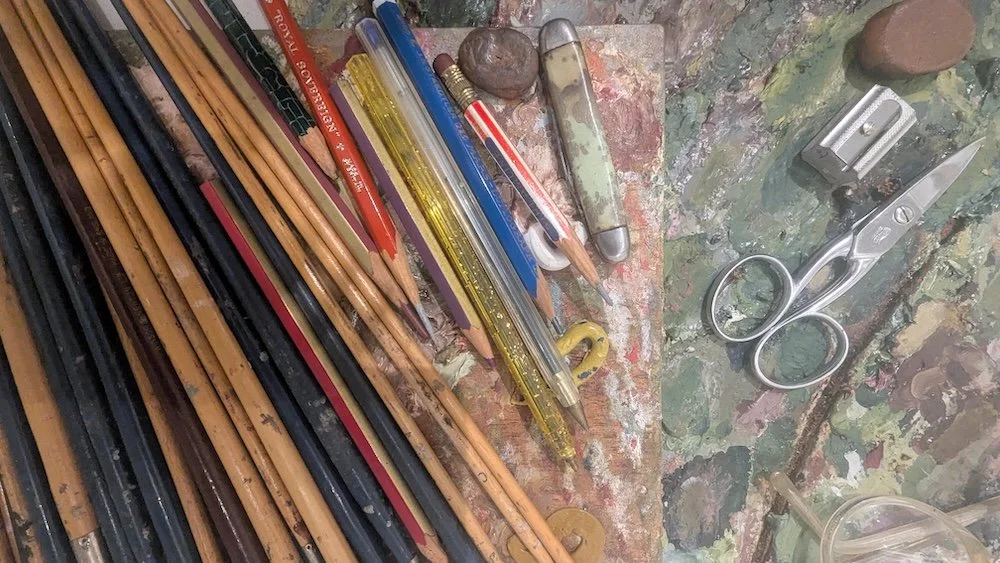
Stanley’s paintbox. Taken at the Stanley Spencer Gallery in Cookham.
Strange Heavens is a new long-form musical work – songs, spoken text, traditional folk material, found sound, and music hall, woven into a single continuous piece inspired by Sir Stanley Spencer's masterpiece at National Trust Sandham Memorial Chapel in North Hampshire. It's a collaboration with writer and editor Rich Lines, supported by the Basingstoke and Deane Borough Creative Incubator Fund, and aimed at an album release, tour and chapel performance in 2027, one hundred years on from the time Spencer was working there.
If you’re not sure who Stanley Spencer was, or want to know more about his work, I highly recommend this lovely documentary featuring the insights of one of his biggest celebrity fans, Billy Connolly.
I'll be blogging about the project as it's made, on and off:
From Ghosts to Strange Heavens: Jon Wilks on Stanley Spencer, Folk Music and Sandham Memorial ChapelStrange Heavens: the band, the songs, and what we found in Stanley Spencer's Cookham
Here’s the second missive.
Bury St Edmunds
I went up to Rich's place at the end of June, where we got the chance to work on the songs properly. Until now, we had worked together in Sandham Memorial Chapel, discussing ideas as they came to us, making copious notes, and eating pies in the pub across the road. Bury was the first opportunity we've had to couple together the words Rich has come up with the music I've been writing. Amazingly, we came out of a two-day writing session with four or five of the major pieces completed. It's now being prepped for recording. I had genuinely worried, going in, that the whole premise – music that feels like floating through Stanley's dream – might be a bit mad. Turns out that's the fun of it. The songs are sequencing together in a way that's surprised both of us.
Studio plans
We're laying down the basic tracks at Abbey Road in September, with vocals and other instrumental parts to be recorded in the chapel itself. Joining us, wherever we end up: Jon Nice, a founding member of the Grizzly Folk collective; Nina Smith, a young singer and fiddle player who lives near the chapel itself and studied under Sam Sweeney; Albert Hansell, our beloved sound engineer and one of the country's best Morris dancers (which is important for mid-session entertainment – dance, Albert, dance!); and a local brass band, bringing some proper regimental colour to the record. The horns aren't just colour. Spencer's chapel is a war memorial, and brass was the sound of that war – military bands, hymn tunes played by regimental musicians, the kind of thing that would have drifted across a camp in Macedonia or rung out at a homecoming. It felt wrong to leave that texture out.
Jon Nice, our resident techno-boffin, has also decided he's going to take a digital reading of the chapel while we're there. I'm not entirely sure what this involves, but the gist, as I understand it, is that he'll digitally recreate the acoustics of the space itself, so that when we mix the record, or play it live, the reverberations you hear are an actual imprint of Sandham Memorial Chapel. Mindblowing.
The title track, and What-Ho Giotto
The title track, ‘Strange Heavens’, is Rich's response to the first time he walked through that heavy door at Sandham and took in what's inside. Anyone who's been will know the effect the place can have. I once went with Martin Carthy on a day off during our 2023 tour together, and when I visited him in Robin Hood's Bay a few weeks ago, I asked if he still thought about it. "My gosh," he said, "I think about that place so often. It has stayed with me." It seems to work that way on most people – some find it uplifting, some find it almost oppressive in its intensity, but very few leave unmoved. I took my son there recently – he's twenty-two, a musician himself – and he wasn't all that taken with it at the time. A month or two on, he confided he can't stop thinking about the place. It lingers. It's dreamlike. It's certainly taken over a large part of my waking, and sleeping, hours these past eighteen months.
So ‘Strange Heavens’ is Rich's first response to all that. I remember him being struck almost mute by the place when we first walked in together – Rich, who is fascinated by Stanley Spencer, by the First World War, by the business of putting things into words, went more or less silent for half a day. It took a lunchtime pint in the Carpenters Arms before the words started coming back. The song carries something of that – hymnal, slow, and quietly moving – and it's going to sound extraordinary when we finally perform it in the chapel itself next year.
‘What-Ho Giotto’, by contrast, is a song of lists. That's not to make it sound dry – it isn't, it's frenetic, essentially a music hall romp. I think of it as Rich's second response to the chapel: where ‘Strange Heavens’ is the silence, ‘What-Ho Giotto’ is what happens once the words come flooding back and there's simply too much to take in. There's so much to see in there that the song becomes an attempt to put it all into some kind of order – mentally cataloguing what's in front of him, physically and spiritually, and questioning at every turn whether he's looking at Stanley, or at something larger moving through Stanley's reverence for the everyday.
Because that's the heart of Spencer's work – finding the extraordinary in the ordinary. He found heaven on earth in the streets of Cookham, where he grew up, and he found it again in the cooking – and burning – of bacon in the Macedonian hills; in the wafting smells of freshly baked bread in his mother's kitchen and the Beaufort War Hospital; in the delights an army dog might take in licking clean a Fray Bentos tin. There's a line in the documentary above where Billy Connolly sums it up with a sparkly eye and a familiar chuckle: "What you are is important. Never mind striving to be an angel. Be a great grocer." I think that's a huge part of Stanley Spencer's ethos. ‘What-Ho Giotto’ is Rich trying to take all of that in.
Rich's third response is ‘Strange Hells’ – his attempt to come to terms with the fact that what's on the walls of Sandham doesn't line up with our usual reading of the First World War. There's no sign here of Sassoon or Owen, none of the imagery we've all absorbed as the standard-issue horror of the trenches. Musically, it's the closest we get to something like psych-folk, maybe even White Album-era Beatles.
You see, working on this song has revealed something to me about my own role as a musician, too (please forgive the pretentious navel-gazing). Whatever reputation I have has been built on the back of traditional English music, and yet I've never been entirely comfortable being called a folkie, or a folk singer. I think of what I do as making music that reflects where I'm from. There are images that live in my head – shadow and light across a Warwickshire field at the long end of summer, the dark green of the Whitchurch Hangings, the canal bridges at Gas Street Basin, the factory streets around Digbeth – and I want to find ways to put them into song. Who knows why. Folk songs are one of the palettes I draw from, but so are other English strands – Nick Drake, Syd Barrett, the Beatles, Robert Wyatt. My attraction to Stanley Spencer comes from the same place. I can see what he's trying to do. It's his world, and it's a world I recognise.
What Stanley would have heard
This weekend just gone, Nina and I got together to dig into the traditional songs and tunes Stanley might have known. Nina's got a far better feel for this material than I do, and it was a genuine pleasure watching her work through it.
We spent time on 'Green Bushes', which was collected in Cookham Dean while Stanley was still a child. We can't claim he definitely knew it, but it's unmistakably of his time and place, and I'm always inspired by that combination – the psychogeography of traditional folk music. We also looked at 'Her Bright Smile Haunts Me Still', which became the signature tune of the Royal Army Medical Corps only two years before Stanley arrived at Beaufort – which makes it close to a certainty that he'd have known it well.
None of this is decoration. The idea is to put our own response to Stanley's art alongside the music we believe would genuinely have been part of his world – and we know he loved music. His father was a music teacher, and Bach was a particular passion. All of these fragments are still being explored, but they're starting to feel like they belong.
The plan for the live shows is to build them in two halves. The first will be given over to the traditional, music hall and First World War songs Stanley might have known – the material Nina and I have been digging into. After the interval, we'll perform Strange Heavens in its entirety, whatever that ends up looking and sounding like by the time we get there.
Seeing it live
If you'd like to see Strange Heavens performed in the chapel itself, it's worth saying something sooner rather than later – seating there is extremely limited, and we're still working out how many performances we can give.
We're also taking the show on the road, and we've been in discussion with a number of record labels about the project. London, Manchester, possibly Bristol, Birmingham, Cookham, and Sandham Memorial Chapel itself are all in the frame, with more places likely to be added.
More as it develops.
Jon
