From Ghosts to Strange Heavens: Jon Wilks on Stanley Spencer, Folk Music and Sandham Memorial Chapel
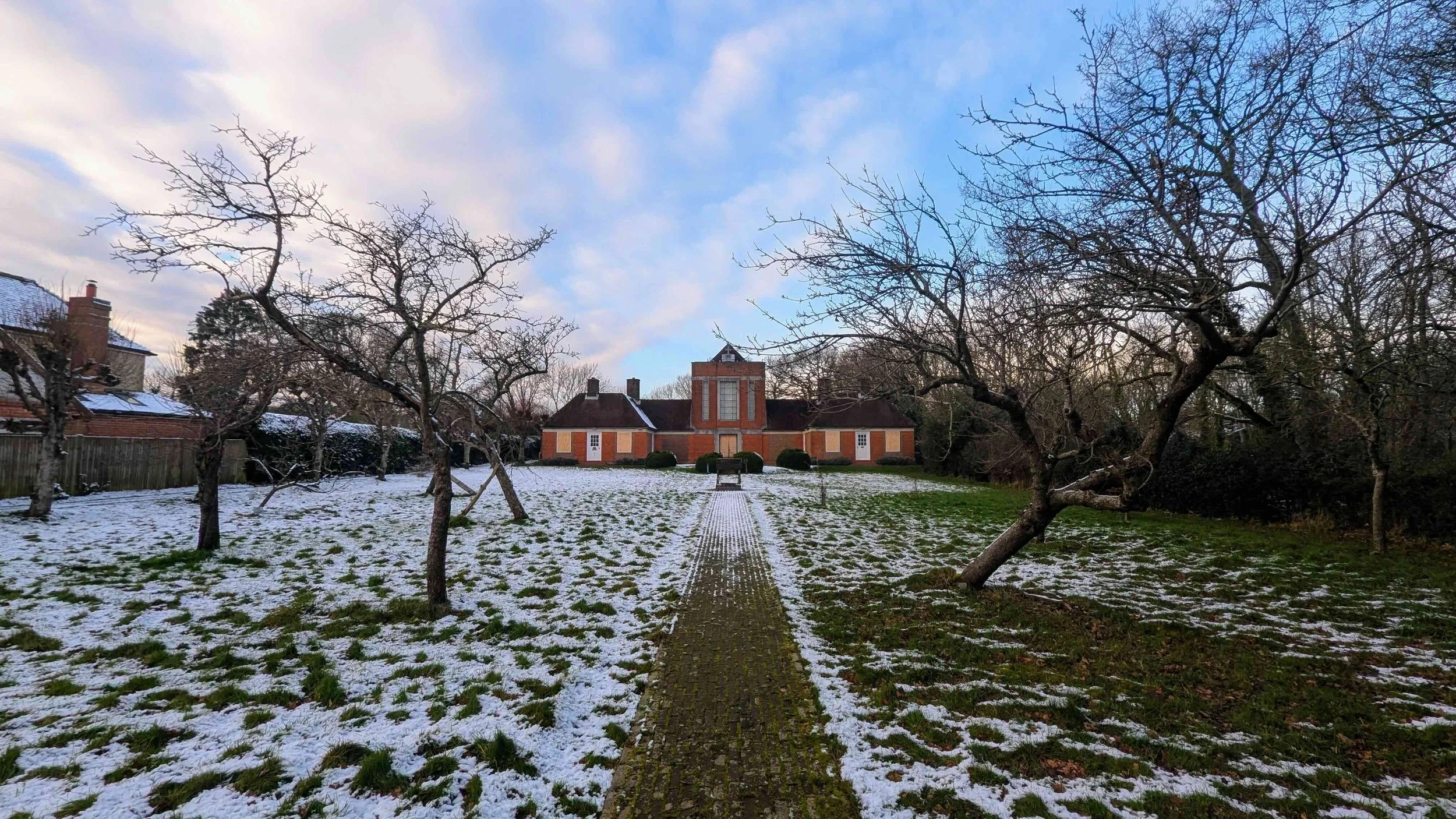
Sandham Memorial Chapel, Burghclere, in the snow.
What is Strange Heavens?
Strange Heavens is a new long-form musical work by folk musician, Jon Wilks, and writer and editor Rich Lines, inspired by the paintings of Sir Stanley Spencer at National Trust Sandham Memorial Chapel in North Hampshire.
The piece weaves original songs, spoken text, traditional folk material, found sound, and songs from the music hall and the First World War period into a single continuous performance of around 30 minutes.
The project is intended to be performed at Sandham Memorial Chapel, along with other venues across the country, and has been supported by Basingstoke and Deane Borough Creative Incubator Fund. It is currently in a planning phase, with agreements to perform it at significant venues in London and Manchester, amongst others. An album release is planned for 2027.
I'll be blogging about the project as it's made, on and off:
How it began
Jon Wilks explains…
This project started life as something else entirely.
A few years ago I began thinking about an album I was calling Ghosts. The idea was to create a continuous, seamless collection of traditional songs that faded in and out of a kind of aural ether, as though you were wandering through someone’s dream — material emerging and dissolving, like half-remembered things.
The concept kept developing, and then something happened that changed its direction completely.
The chapel
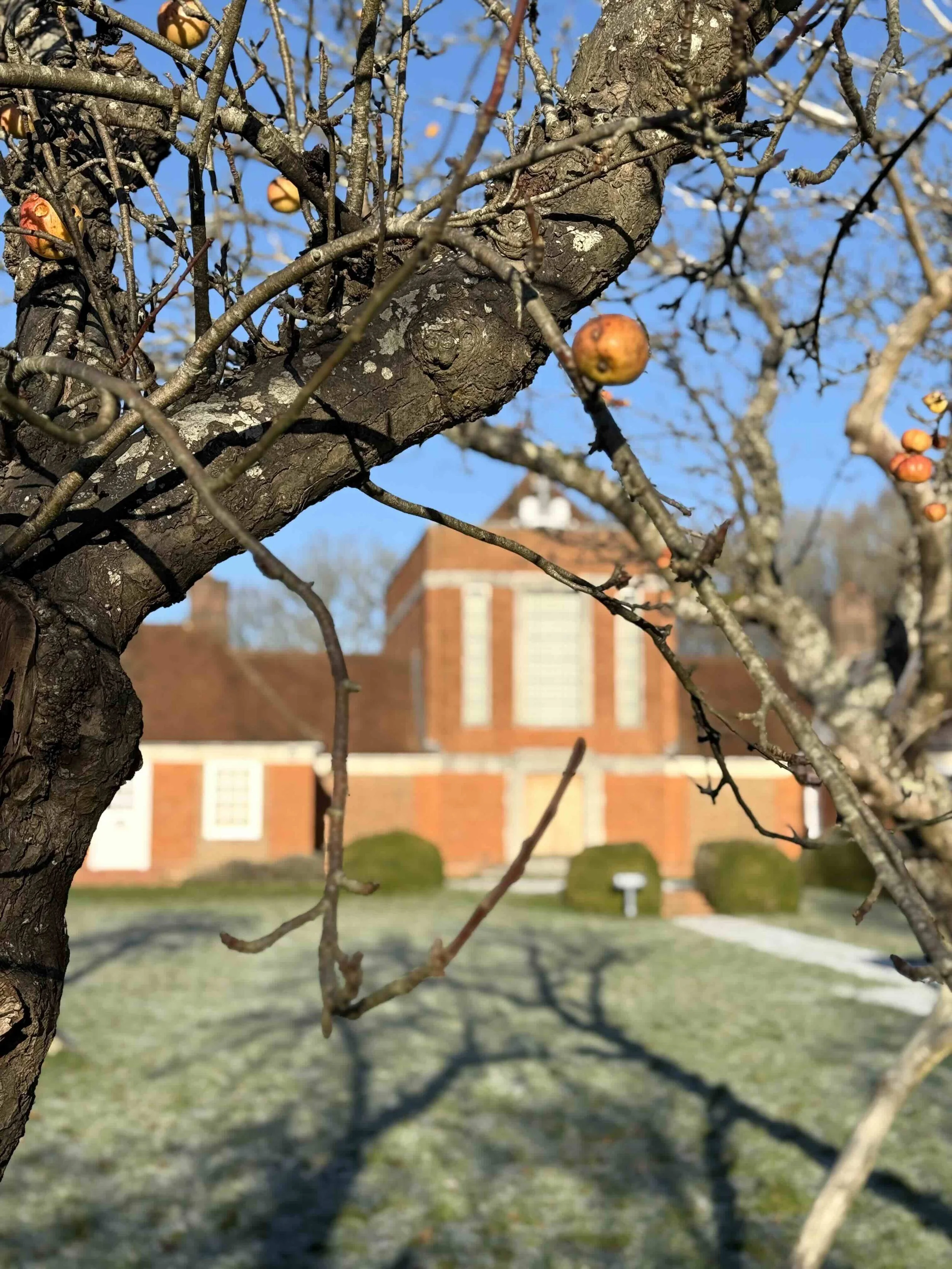
Sandham Memorial Chapel framed by a bare apple tree on a frosty morning.
A few miles from my home in Whitchurch, in the North Hampshire village of Burghclere, there is a small chapel that contains one of the greatest achievements in twentieth-century British art. Astoundingly, most people have never heard of it.
I had visited Sandham Memorial Chapel when I first came to live in this part of the world, but it wasn’t until a visit during my tour with Martin Carthy that it truly struck me. We had a day off from the tour and went along, and I was bowled over (as was Martin). I kept going back — it’s only a few miles from my house after all — and I was struck both by how continuously involving it is, and by how little it seems to be known.
I couldn’t get over that second point. We know the war poets so well. Wilfred Owen, Siegfried Sassoon: they’re taught in schools, they’re part of the national conversation about the First World War. And yet here is this extraordinary visual work by Stanley Spencer, and it seems to be spoken about only by people already in the know. How can that be? Why aren’t we all taught about it when we learn about the First World War?
Spencer painted the chapel’s interior between 1926 and 1932 as a memorial to those who served, and in particular to the overlooked dead of the Salonika campaign. Every wall is filled with scenes of hospital life, military labour and quiet human dignity, rendered with an almost hallucinatory intensity. But what moves me most is its spirit. Its dedication to community, camaraderie, and to something spiritual — in whatever form Stanley intended that to be — is such an antidote to the hell of war.
What I’ve found is that you can go in there again and again and discover a hundred new points of interest every time. Because the chapel has no electric light, the experience is entirely organic, shaped by the landscape and the elements in the moment you’re there. I’ve been inside on a spring day and seen explosions of blossom, revealed to me quite suddenly by an urgent, pointing finger of sunlight. I’ve also been there when the rain moves in and the winter light vanishes, and suddenly you’re surrounded by encroaching, virulent darkness: hundreds of faces and eyes hovering around you, the awkward, insistent presence of Stanley there on your shoulder. I’ve been drawn in by the beauty. I’ve also been forced to leave by the sheer heft of it all. It is an immensely powerful piece of work.
Rich Lines
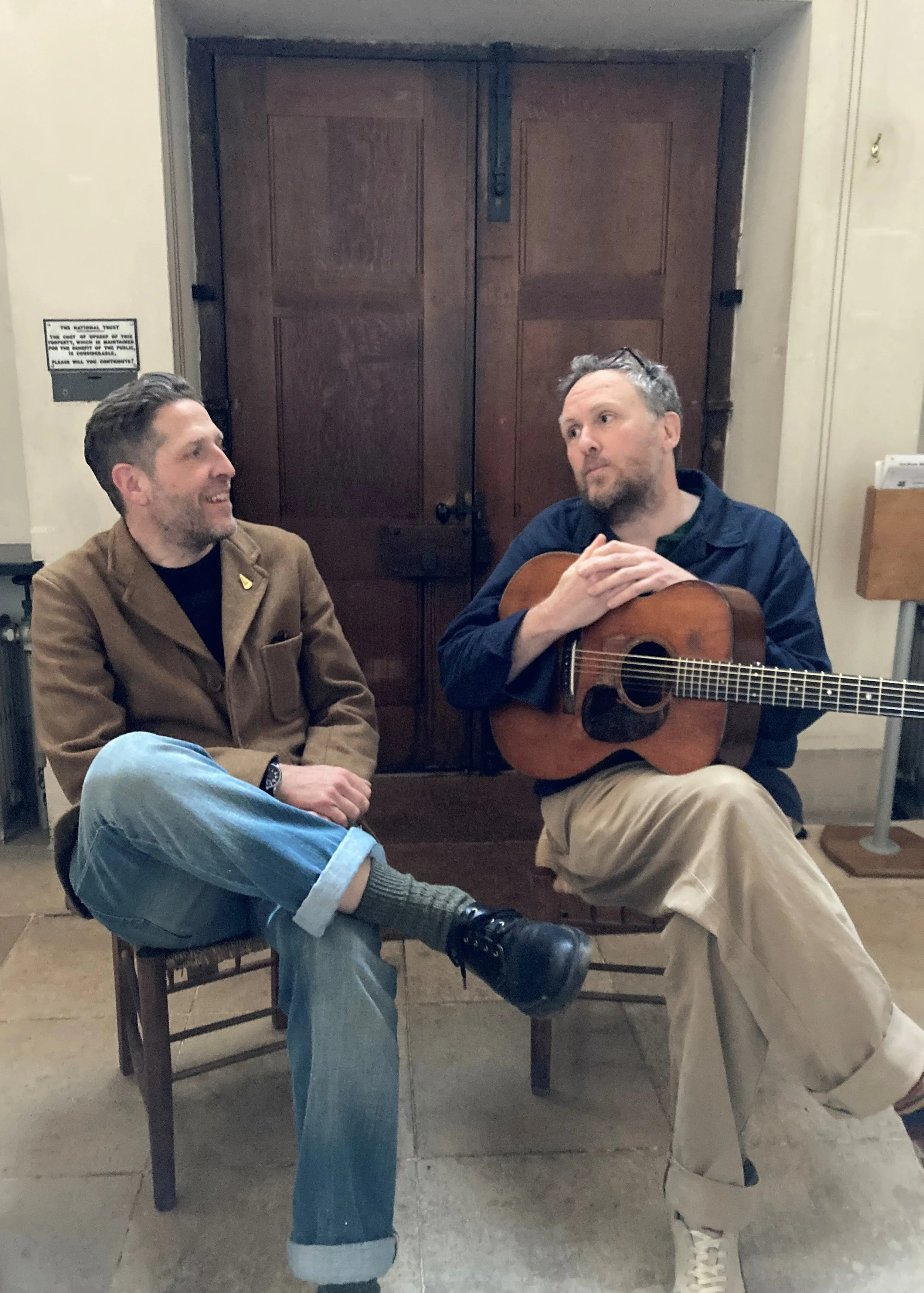
Richard Lines and Jon Wilks in conversation inside Sandham Memorial Chapel, Jon with guitar.
I should say something about my collaborator, because there would be no project without him.
Rich and I met at Solihull Sixth Form College in the 1990s. We played in bands together, busked together in Birmingham; shared that open-eared and wide-eyed passion that culture-guzzling teenagers can have for music and the written word. We wrote together, too, and have continued to do so sporadically ever since, occasionally as part of the Grizzly Folk collective I’ve worked with for a couple of decades now. He was as in love with words as I was with guitars, and that hasn’t changed. In his working life he’s a writer and editor — for Future Publishing among others, for Time Out in a former life, and for Tradfolk back when I was running it — but it’s his quieter creative work that has always struck me most. He’s a genuinely wonderful writer, and I’ve adored his lyrics for as long as I’ve known him.
When I began to understand what Strange Heavens might become, I realised fairly quickly that I didn’t want to write the words myself. I wanted Rich to write them. He has a way of finding his way into a subject that eludes me entirely — a particular angle of approach; a patience with ambiguity. I knew that Spencer’s world would fascinate him just as much as it fascinates me. Stanley is a man well worth finding out more about: odd, visionary, contradictory, deeply strange. Rich took to him immediately.
We’ve spent a good deal of this project sending each other little Stanley discoveries. “Have you SEEN this?” It has been a joy to explore the treasures of what he called his ‘holy box’, the chapel itself, with my dear old friend.
The music
I’ve been asked what Strange Heavens sounds like, and it’s not an easy question to answer. Perhaps it’s easier to describe the things I was listening to when the idea came to me.
Paul Simon’s Seven Psalms made a deep impression on me: that sense of a single continuous piece holding many different emotional registers, moving between the intimate and the vast, folding back on itself as only a song cycle can. The Shovel Dance Collective’s The Water is the Shovel of the Shore pointed at something else: the way that traditional material reflects memory, collective or otherwise, and that psychogeography is as relevant to music as it is to any other art form, if not more so. Time, place and the aural experience can really tattoo your brain. This is music with a postcode. I want Strange Heavens to belong as much to Burghclere as Stanley’s paintings belong to Cookham.
Further back, I studied Pierre Schaeffer at university and have never entirely shaken off an interest in musique concrète, in found sound and the texture of the world as musical material. And perhaps the piece that has stayed with me longest, and that feels most directly relevant here, is Gavin Bryars’ Jesus’ Blood Never Failed Me Yet — the way it moves in and out of solidity and structure, the way a fragment of something half-heard appears to carry the entire weight of a life — always seemed to me to be about the echo of memory: the way certain things persist, surface, dissolve, and return. When I stood inside Sandham Memorial Chapel and looked at those murals, I felt something similar. Spencer had done it in paint.
I’m aware that all of this might sound as though I’ve wandered even further off the beaten folk track than I did on Needless Alley. In fact, I think of it as closer to the traditional work I’ve done throughout the early solo albums I made. Spencer was raised the child of a musician and had a deep love for music all his life. He also had a profound attachment to place, to Cookham in particular, and will have heard and known traditional, local songs, even if that terminology probably meant nothing to him. His letters make reference to hearing other soldiers singing traditional songs in the hospital and on the front. What we now call traditional folk music was most likely a far more present and natural part of his world than it would be ours, embedded in the fabric of everyday life in a way we can only imagine. It seems right, then, that it should be embedded in ours too, woven into the dreamlike sounds we’re trying to create, rather than sitting apart from them.
At least, that’s the intention. I’ve never taken on anything quite this ambitious, and we’re still very much in the midst of it. Whether we’ll pull it off is another question entirely, but that uncertainty feels right for a project rooted in a place as quietly astonishing as Sandham. You go in not quite knowing what you’ll find.
The project
With the generous support of the chapel team, I was given a rare day alone inside with my guitar. That day was the beginning of the work proper. Rich and I have since been allowed in repeatedly, and we’ve been building the piece ever since, weaving his text and lyrics into the music, finding the shape of something that is still revealing itself to us.
The ensemble
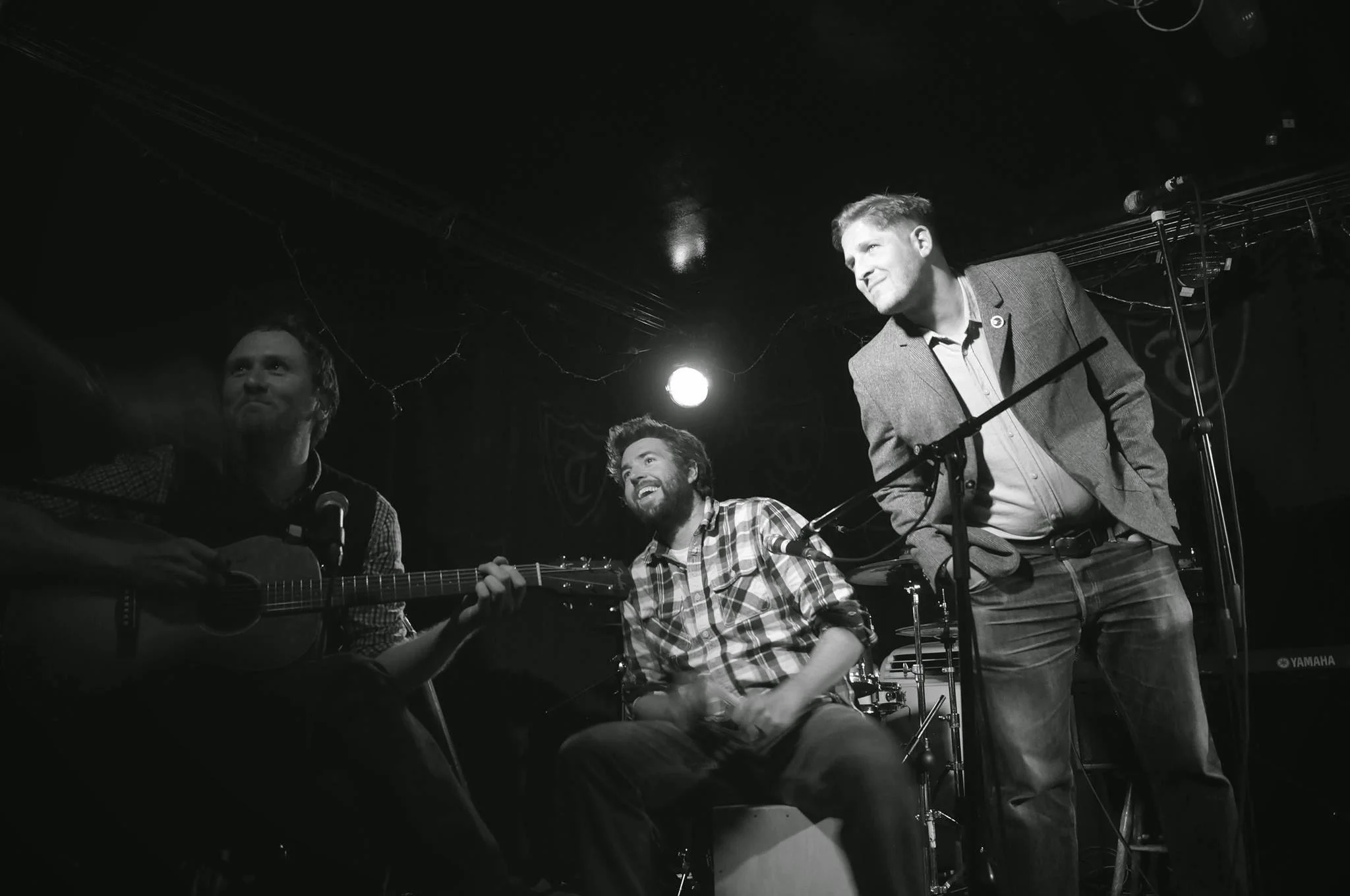
Jon Wilks, Jon Nice and Richard Lines of The Grizzly Folk at the Troubadour, Earl's Court, 2014. Photo: Miriam Nice.
Joining Jon and Rich in both the live show and on the recording are collaborators who have been part of Jon’s musical world for some time.
Jon Nice has been part of the Grizzly Folk collective — a founding member, in fact — since it began in Japan in 2007, when the duo set out to play traditional English music, amongst other things, to a bewildered crowd of Japanese people. He has been an important part of almost every piece of work that Jon has done since then, and is a true soundsmith if such a word exists and if ever there was one.
Nina Smith is a young musician who lives near to the chapel itself, and who studied under Sam Sweeney as part of the National Youth Folk Ensemble. A wonderful singer and fiddle player who writes her own music too, she was also involved in the development of Whitchurch Folk Festival as a friend of the late Paul Sartin, and has been part of Hampshire Youth Folk Ensemble. That she should be part of a piece so rooted in this particular corner of North Hampshire feels entirely right.
The album will be recorded and mixed in part by Albert Hansell, a young and rapidly emerging engineer whose credits include Needless Alley, the Brown Boots Boogie Band, Alvar Smith, live work for Broadside Hacks, and numerous others. He is a familiar presence on sound desks at folk events across the country, and he works regularly with Whitchurch Folk Club and Whitchurch Folk Festival. We are very keen to involve young musicians and creatives whose lives and work are already woven into this part of the world, and Albert is a fine example of exactly that.
Dates and the recording
If you programme folk, contemporary acoustic, or heritage-connected work and think Strange Heavens might be a fit for your venue or festival, please contact my agent Claire Patterson via my Midnight Mango agency page.
The music is being recorded for album release in 2027. More details on dates and the album as things develop.
